Indian industry stands at a unique inflection point. Vast legacy infrastructure — some of it decades old — coexists with cutting-edge technology on the same factory floor. The engineers who can bridge these two worlds hold the key to India's industrial future.
The Indian Factory Floor: A Tale of Two Eras
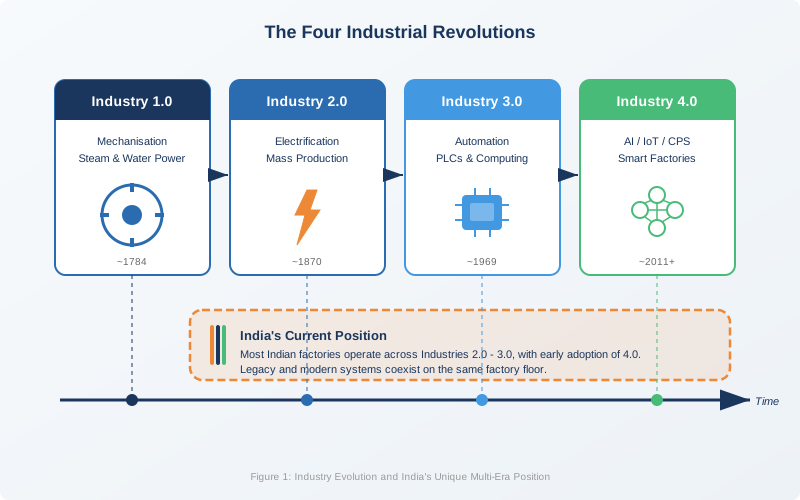
Walk into a mid-sized manufacturing plant anywhere in India — Pune, Coimbatore, Bengaluru, or the NCR belt — and you will encounter a scene that is remarkably common yet rarely discussed in global Industry 4.0 literature. On one side of the shop floor sits a CNC machining center installed last year, complete with Ethernet connectivity and OPC-UA support. Fifteen metres away, a 30-year-old lathe hums along reliably, driven by analog controls, tended by an operator who has been running it since before the Internet arrived in India.
This is not an anomaly. It is the norm.
India's manufacturing sector — contributing roughly 17% of GDP and employing over 27 million people — is overwhelmingly brownfield. Unlike nations that industrialised in a single wave, India's industrial base has accumulated layer upon layer of technology across decades. Mechanical systems from the 1970s, electrical automation from the 1980s, early PLCs from the 1990s, and modern IoT-enabled equipment from the 2020s all share the same roof.
Why Brownfield Beats Greenfield in India
The global Industry 4.0 playbook often assumes greenfield deployment: purpose-built smart factories designed from the ground up. In India, the calculus is different.
Scale makes replacement impractical. India has an estimated 12 to 15 million MSMEs in manufacturing alone. The majority operate with equipment that is functional, paid off, and well understood by their workforce.
Indian industry's strength is in jugaad — the ability to make things work with available resources. This aligns naturally with brownfield modernisation: retrofit a vibration sensor on that 30-year-old lathe, add a current transformer to monitor the spindle motor, connect a protocol converter to the legacy PLC. Suddenly, a machine that was invisible to the digital world begins to speak.
Brownfield approaches preserve institutional knowledge. The operator who has run that lathe for three decades carries irreplaceable understanding of its behaviour — the subtle sound change before a bearing fails, the feed rate that works best for a particular alloy. Ripping out the machine means losing that knowledge. Augmenting it means amplifying it.
The Practical Toolkit: Adding Intelligence to Legacy Systems
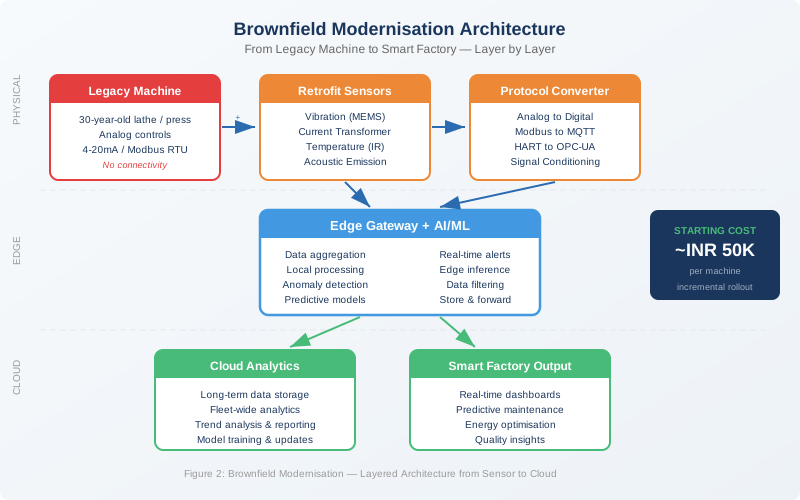
The technology stack for brownfield modernisation has matured significantly, and much of it is now accessible at Indian price points. The approach follows a layered architecture.
Layer 1 — Retrofit Sensors. Non-invasive sensors are the foundation. Clamp-on current transformers, adhesive-mounted vibration sensors (MEMS accelerometers), infrared temperature sensors, and acoustic emission sensors can be added to virtually any machine without modification. The cost has plummeted: a capable MEMS vibration sensor now costs under INR 500, and industrial-grade current sensors under INR 1,000.
Layer 2 — Protocol Converters and Data Aggregation. Legacy machines speak a babel of protocols — Modbus RTU, HART, 4-20 mA analog loops, or sometimes no protocol at all. Protocol converters and industrial IoT gateways translate these into modern formats: MQTT, OPC-UA, or REST APIs.
Layer 3 — Edge Computing. Raw sensor data from a legacy machine is noisy, context-dependent, and voluminous. Edge computing — processing data at or near the machine — reduces bandwidth requirements, enables real-time responses, and keeps sensitive operational data on-premises. AI/ML models running at the edge can detect anomalies, predict failures, and optimise processes without depending on cloud connectivity.
Layer 4 — Cloud Analytics and Dashboards. Aggregated, processed data flows to cloud platforms for long-term trending, fleet-wide analytics, and management dashboards.
The beauty of this layered approach is that it is incremental. A factory can start with Layer 1 on a single critical machine for under INR 50,000 and expand as results justify further investment.
The Real Barriers: Cost, Skills, Infrastructure, and Mindset
Cost sensitivity is paramount. Indian MSMEs operate on thin margins. A solution that costs INR 5 lakh per machine is a non-starter for a shop with ten machines and annual revenue of INR 2 crore. The retrofit-and-augment approach — starting at INR 30,000-50,000 per machine — is critical. The ROI must be demonstrated quickly.
Skills gaps are real but nuanced. India produces over 1.5 million engineering graduates annually, many with exposure to IoT and data science. What they often lack is domain knowledge — understanding what a particular vibration signature means on a specific type of machine. Conversely, experienced plant engineers with deep domain expertise often lack familiarity with data protocols and ML concepts.
Infrastructure remains a challenge. Reliable Internet connectivity, stable power supply, and basic IT infrastructure cannot be assumed on Indian factory floors. This is why edge computing is not merely a technical preference in India — it is a necessity.
Mindset is perhaps the most underestimated barrier. Many factory owners who built their businesses on analog expertise view digitalisation with scepticism. The most effective counter is not a technology pitch but a demonstration: show them their own machine's data, reveal the hidden inefficiencies, and let the numbers make the case.
The Bridge Builders: When Analog Meets Digital
This brings us to what we believe is the most critical success factor for India's Industry 4.0 journey: the collaboration between engineers who understand legacy systems and those who understand modern digital technologies.
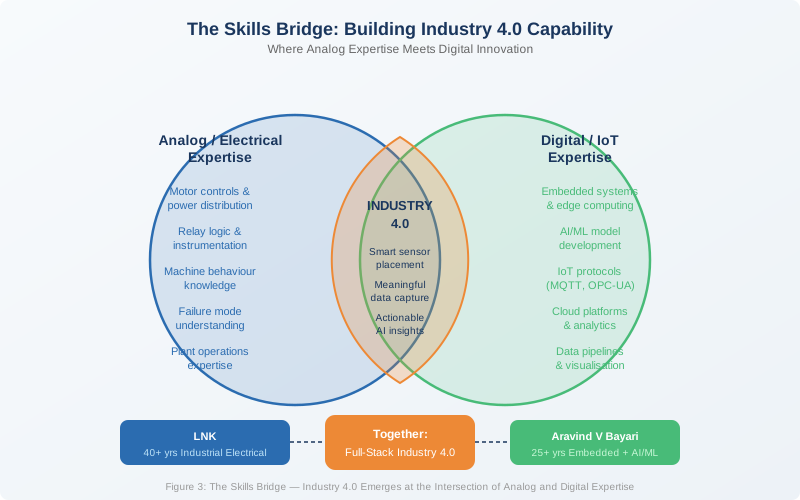
The two of us are, in many ways, a case study of this model. LNK brings over 40 years of experience in industrial electrical systems — from motor controls and power distribution to relay logic and instrumentation. He has seen Indian industry evolve from entirely manual operations through the first wave of automation to the edge of the digital era. Aravind brings 25+ years of embedded systems experience and has transitioned into AI/ML at the edge — designing systems that can learn from sensor data and make decisions in real time.
Neither of us alone could deliver what Industry 4.0 demands. LNK knows which measurements matter on a legacy machine, where sensors should be placed, what the failure modes are, and how the plant actually operates. Aravind knows how to capture that data, process it at the edge, train models on it, and deliver actionable insights. Together, we cover the full stack from the physical world to the digital one.
Across India, the most successful Industry 4.0 implementations share this pattern: teams that combine deep domain expertise with modern digital skills. The 55-year-old plant manager and the 28-year-old data scientist, working together, achieve what neither could alone.
Upskilling: The Bridge Goes Both Ways
For India to scale its Industry 4.0 transition, upskilling must flow in both directions.
Experienced analog and electrical engineers need structured exposure to IoT architectures, data communication protocols (MQTT, OPC-UA), cloud platform basics, and an understanding of what AI/ML can and cannot do. They do not need to become software developers — they need to become informed collaborators and requirement-setters.
Young digital engineers need immersive exposure to real factory environments. No amount of simulation replaces the experience of standing next to a running machine, feeling its vibrations, hearing its sounds, and understanding why the operator adjusts the feed rate by ear.
Industry bodies such as CII and NASSCOM have begun addressing this through joint training programmes. But the pace needs to accelerate, and the content must be grounded in the Indian brownfield reality rather than imported wholesale from Western greenfield playbooks.
Success Stories: Incremental Wins That Build Momentum
The evidence for brownfield modernisation is growing.
A textile mill in Coimbatore retrofitted vibration and temperature sensors on its spinning frames — machines averaging 20 years of age. Edge-based anomaly detection reduced unplanned downtime by 18% in the first six months, with a total investment under INR 3 lakh per machine.
An auto-component manufacturer in Pune added current monitoring to its legacy press shop. By analysing power signatures, the team identified tooling wear patterns that had previously been caught only by visual inspection. Rejection rates dropped by 12%.
A steel re-rolling mill in Jharkhand, operating with equipment from the 1990s, deployed edge gateways to collect data from its existing PLCs and analog instruments. For the first time, plant management had real-time visibility into energy consumption per tonne of output — and the insights drove a 9% reduction in specific energy consumption within one quarter.
These are not headline-grabbing, billion-dollar smart factory stories. They are practical, incremental, and replicable — exactly what India's industrial fabric needs.
The Road Ahead
India's path to Industry 4.0 will not mirror Germany's or China's. It will be characteristically Indian: heterogeneous, incremental, cost-conscious, and powered by the ingenuity of engineers who refuse to accept that old and new cannot coexist.
The next five years will be decisive. As sensor costs continue to fall, as edge computing becomes more powerful and affordable, and as a new generation of engineers enters the workforce with both digital skills and industrial exposure, the conditions for rapid scaling are falling into place.
The critical enabler, however, is not technology. It is people — specifically, the bridge builders who can translate between the analog world and the digital one, who can look at a 30-year-old machine and see not obsolescence but opportunity, and who understand that Industry 4.0 in India is not about replacing what works but about making it work smarter.
That is the transition we are living, and we invite fellow engineers — whether your expertise is in relay logic or neural networks — to join the journey.