The Scale of the Problem
India's industrial electrical accident statistics are grim, though the true numbers are almost certainly worse than official records suggest. The Central Electricity Authority's annual reports consistently document over 400 fatal electrical accidents per year in utility and industrial settings alone. Independent estimates, accounting for unreported incidents in small and medium enterprises, place the real figure significantly higher.
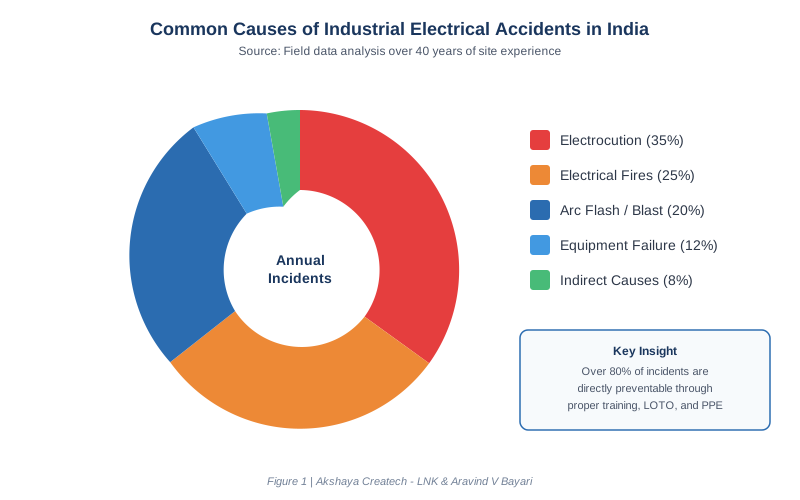
The most common categories of industrial electrical accidents in India are:
- Electrocution from direct contact (~35%) — workers touching live conductors during maintenance, often without proper lockout-tagout (LOTO) procedures.
- Arc flash and arc blast (~20%) — catastrophic energy releases during switching operations or fault conditions, causing severe burns and blast injuries.
- Electrical fires (~25%) — originating from overloaded circuits, deteriorated insulation, loose connections, and improper cable management.
- Equipment failure and explosion (~12%) — transformer failures, capacitor bank explosions, and DG set incidents due to deferred maintenance.
- Indirect causes (~8%) — falls from height triggered by electric shock, secondary injuries from startled reactions near live equipment.
Each of these categories is preventable. The fact that they persist, year after year, points not to a lack of knowledge but to a systemic failure in how that knowledge is transmitted, practiced, and enforced.
The Regulation-Practice Divide
India does not lack regulations. The CEA (Measures Relating to Safety and Electric Supply) Regulations 2010, the Indian Electricity Rules 1956, and the IS standards for electrical installations (IS 3043 for earthing, IS 732 for wiring) are technically sound documents. The Factories Act 1948 and state factory rules mandate periodic electrical inspections. ISO 45001:2018 adoption is growing among larger firms.
The problem is implementation. In our experience across hundreds of site visits over four decades, we have observed a consistent pattern:
Regulations exist on paper, but rarely in practice. Electrical safety manuals gather dust in HR offices. The safety officer — where one is even appointed — is often a mechanical or civil engineer with no specialised electrical training.
Training is treated as a formality. Workers attend a half-day "toolbox talk" when they join, sign an attendance register, and never receive refresher training. The content is generic — slips, trips, and falls — with electrical hazards covered in a single slide, if at all.
Cost-cutting overrides safety. In competitive manufacturing environments, maintenance budgets are the first to be squeezed. Preventive maintenance schedules for switchgear, transformers, and cable systems are deferred. When an electrician raises a concern, they are told to "manage" until the next shutdown.
What Four Decades on Site Have Taught Us
Where Safety Culture Was Real — A Large Printing Facility
During my tenure managing the electrical infrastructure at a large newspaper printing plant — including fire fighting systems, diesel generator sets, and high-voltage transformers — I experienced what a genuine safety culture looks like. This was an organisation that invested in:
- Dedicated electrical safety personnel with clear authority to stop work.
- Regular drills — not just fire drills, but electrical emergency response simulations, including scenarios for transformer oil fires and DG set failures.
- Preventive maintenance without compromise — transformer oil testing on schedule, thermal imaging of switchgear, cable insulation resistance testing at defined intervals.
- Documentation that was alive — single-line diagrams updated after every modification, earth resistance records maintained meticulously, protective relay settings reviewed annually.
This experience demonstrated that safety culture is not about spending more money. It is about institutional commitment.
Incidents Witnessed and Prevented
Over 40 years, I have witnessed and, in several cases, intervened to prevent serious electrical incidents:
The Missing Earth. At a medium-scale manufacturing unit, a routine check revealed that the earth connection to an entire production line had been disconnected during a civil modification six months earlier. Every worker on that line had been operating equipment with no earth protection for half a year. The discovery was accidental.
Arc Flash During Panel Maintenance. A contract electrician opened a live panel to "quickly check" a tripping issue — without de-energising, without PPE, without informing anyone. The resulting arc flash caused second-degree burns. Investigation revealed he had never received arc flash awareness training.
DG Set Room Fire. A diesel generator set caught fire due to a fuel line leak near an improperly terminated cable joint. The fire suppression system had been "temporarily" disabled eight months earlier because of false alarms. The "temporary" bypass had become permanent through organisational inertia.
Transformer Explosion Averted. During a scheduled oil analysis, dissolved gas analysis (DGA) revealed dangerous levels of acetylene, indicating active arcing inside the transformer. The transformer was taken offline. Had the scheduled testing been skipped — as the facility manager had proposed — the transformer would likely have failed catastrophically within weeks.
These are not exceptional cases. They represent the routine reality of Indian industrial electrical safety.
The Safety Maturity Journey
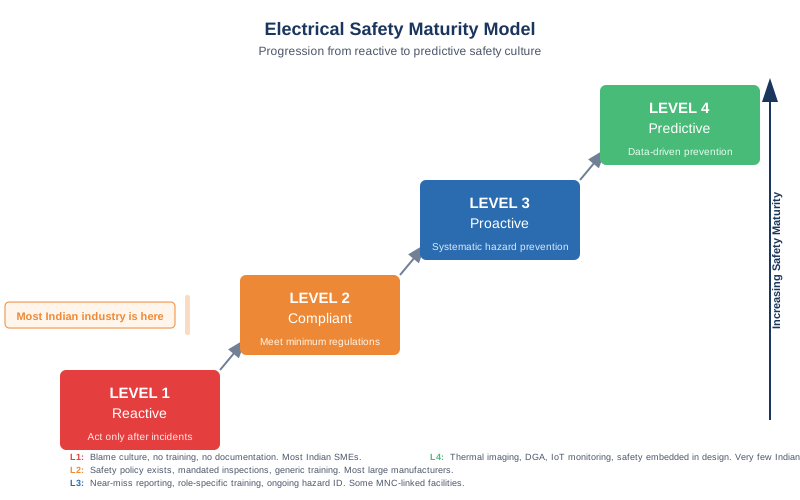
Based on our experience, Indian industrial facilities fall along a maturity spectrum:
Level 1 — Reactive. Safety is addressed only after an incident. No systematic programme. Most small and medium enterprises in India operate at this level.
Level 2 — Compliant. The organisation has a safety policy, conducts mandated inspections, and maintains required documentation. However, compliance is driven by regulatory requirement, not by conviction. This is where most large Indian manufacturers currently sit.
Level 3 — Proactive. Safety is integrated into operations. Hazard identification is ongoing. Near-misses are reported and investigated. A minority of Indian facilities, typically those with multinational parentage, have reached this level.
Level 4 — Predictive. The organisation uses data — thermal imaging trends, partial discharge monitoring, power quality analysis, DGA trends — to predict and prevent failures before they occur. Very few Indian industrial facilities operate at this level, though the technology is readily available.
The journey from Level 1 to Level 4 is not primarily a technology problem. It is a leadership and culture problem.
The Role of the Electrical Consultant in Safety Audits
One of the most under-utilised resources in Indian industry is the independent electrical safety consultant. Unlike generalist safety auditors, an experienced electrical consultant brings:
- System-level understanding — the ability to review a facility's entire electrical architecture and identify systemic risks.
- Standards expertise — current knowledge of IS, CEA, IEEE, and IEC standards as they apply to the specific installation.
- Practical experience — the ability to recognise hazards that do not appear on checklists.
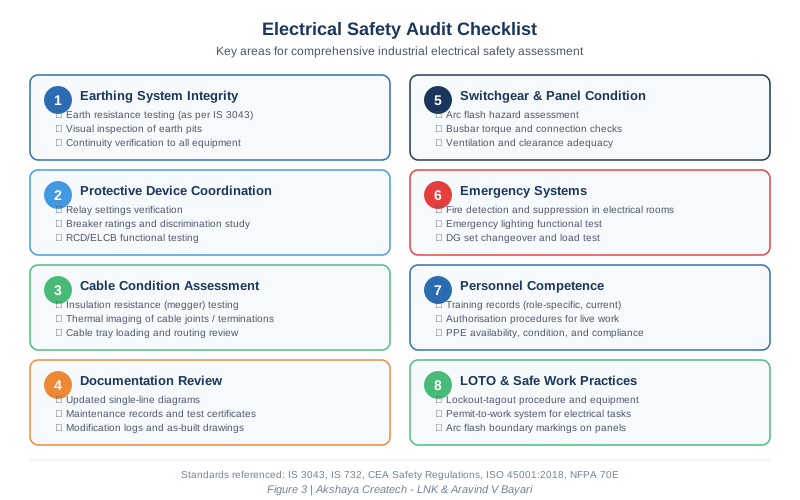
A comprehensive electrical safety audit should cover:
- Earthing system integrity (resistance testing, visual inspection, continuity verification)
- Protective device coordination (relay settings, breaker ratings, discrimination studies)
- Cable condition assessment (insulation resistance, thermal imaging, visual inspection)
- Switchgear and panel condition (arc flash hazard assessment, busbar torque checks)
- Emergency systems (fire detection and suppression, emergency lighting, generator changeover)
- Documentation review (single-line diagrams, maintenance records, test certificates)
- Personnel competence (training records, authorisation procedures, PPE availability)
Emerging Standards and the Path Forward
Several developments offer reason for cautious optimism:
- ISO 45001:2018 adoption is accelerating in India, bringing a more systematic approach to occupational health and safety.
- CEA regulations are being updated to reflect modern practices, including requirements for arc flash hazard analysis.
- NFPA 70E awareness is growing in India, driven by multinational clients demanding compliance from Indian suppliers.
- Digital tools — IoT-based monitoring, thermal imaging with AI analysis, digital twin technology — are making predictive maintenance more accessible.
However, standards alone will not close the gap. What is needed is a fundamental shift in how Indian industry views electrical safety.
Recommendations
Based on four decades of field experience:
-
Make electrical safety training role-specific and practical. Electricians, operators, supervisors, and engineers each need training tailored to their exposure. Training must include hands-on LOTO drills, PPE donning, and arc flash boundary awareness.
-
Mandate independent electrical safety audits. Facilities should engage qualified electrical consultants for comprehensive audits at least annually, with findings tracked to closure.
-
Invest in competence, not just compliance. Hire or develop electrical safety officers with genuine electrical engineering backgrounds.
-
Integrate safety into engineering education. Electrical safety and arc flash awareness should be part of the core electrical engineering curriculum.
-
Use data to drive decisions. Implement condition-based maintenance for critical electrical assets. The cost of thermal imaging and oil analysis is trivial compared to the cost of a transformer failure.
-
Build a reporting culture. Near-miss reporting should be encouraged and rewarded. Every near-miss is a free lesson; every unreported near-miss is a future accident.
-
Hold leadership accountable. Electrical safety performance should be a KPI for plant managers and maintenance heads.
Conclusion
The gap between electrical safety regulation and practice in Indian industry is the predictable result of decades of treating safety as a cost centre rather than a core competence. Closing this gap requires not more regulations but more conviction — from boardrooms to shop floors.
Forty years of site experience have taught us that every serious electrical accident is preceded by warnings — deferred maintenance, skipped tests, untrained workers, ignored near-misses. The organisations that listen to these warnings are the ones where people go home safe. It is as simple, and as difficult, as that.