The Burning Problem — Literally
Every day, thousands of commercial kitchens across India ignite LPG burners to feed millions. Restaurants, cloud kitchens, hospital canteens, hostel mess halls, temple kitchens, and wedding caterers — all running on a fuel source that wastes more energy than it delivers, exposes workers to safety hazards, and saddles operators with rising compliance costs.
Yet when you mention "induction cooking" to a commercial kitchen operator, the response is almost always the same: "That's for homes, not for heavy-duty cooking."
That assumption is wrong — and increasingly expensive to hold on to.
After 40+ years in industrial electrical systems and having commissioned commercial induction kitchen installations across diverse operations, I can say with confidence: commercial induction is not just viable — it's the most financially sound decision a kitchen operator can make today.
The Numbers Don't Lie: LPG vs. Induction
Let's cut straight to the economics that matter to any kitchen operator.
Energy Efficiency
| Parameter | LPG Gas | Commercial Induction |
|---|---|---|
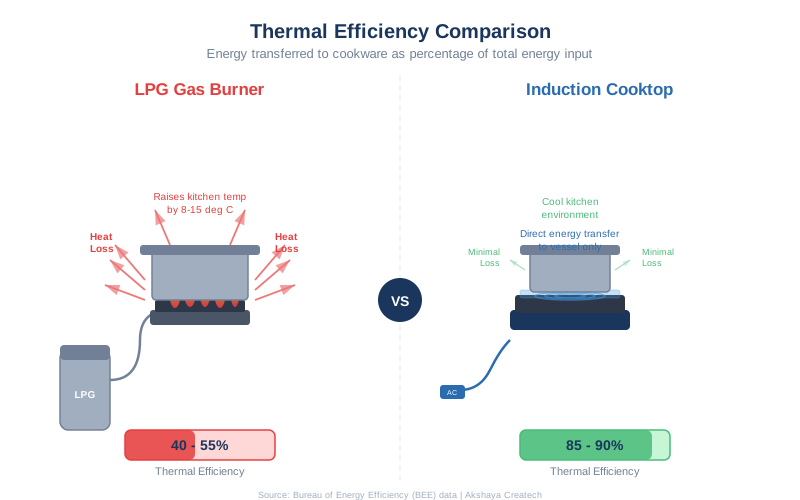
| Thermal Efficiency | 40–55% | 85–90% |
| Heat Loss | 45–60% (radiant, convective) | 10–15% (minimal) |
| Heat-up Time | 8–12 minutes (large vessels) | 3–5 minutes |
| Residual Heat After Off | Significant (wasted) | Near zero |
With LPG, nearly half your fuel cost escapes as waste heat into the kitchen — heating your workers, not your food. Induction transfers energy directly to the vessel through electromagnetic coupling. There is no flame, no combustion gas, and almost no ambient heat loss.
Operating Cost Comparison
Consider a mid-sized commercial kitchen (a cloud kitchen or a 200-seat restaurant) operating 10–12 hours daily:
| Cost Head | LPG (Monthly) | Induction (Monthly) | Savings |
|---|---|---|---|
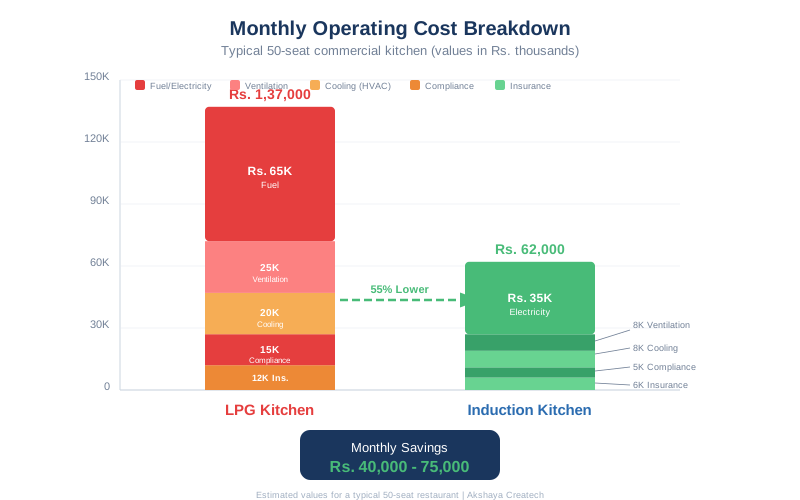
| Fuel / Electricity | Rs. 80,000–1,20,000 | Rs. 45,000–70,000 | ~40% |
| Ventilation / Exhaust | Rs. 8,000–12,000 | Rs. 3,000–5,000 | ~55% |
| Kitchen Cooling (AC load) | Rs. 12,000–18,000 | Rs. 5,000–8,000 | ~55% |
| Gas Safety Compliance | Rs. 5,000–10,000 | Rs. 0 | 100% |
| Insurance Premium | Higher (fire risk) | Lower | ~20–30% |
Total monthly savings: Rs. 40,000–75,000 depending on scale.
The ROI Timeline
For a typical commercial induction installation:
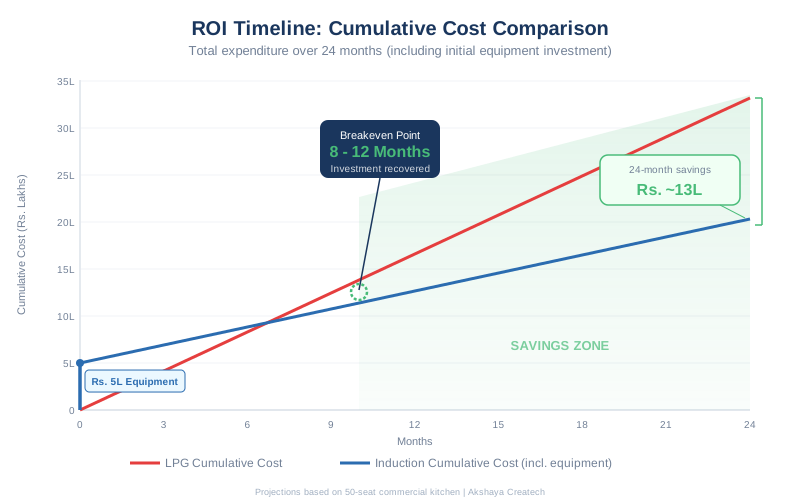
- Capital investment: Rs. 4–8 lakhs (depending on kitchen size and equipment)
- Monthly savings: Rs. 40,000–75,000
- Payback period: 8–12 months
After the payback period, every month is pure margin improvement. Over 5 years, a single kitchen can save Rs. 20–40 lakhs compared to continuing with LPG.
Beyond Cost: The Hidden Burdens of LPG
1. Compliance and Licensing
Operating a commercial LPG kitchen in India requires:
- PESO (Petroleum and Explosives Safety Organisation) license for bulk LPG storage
- Fire NOC from the local fire department
- Regular inspections and renewals
- Compliance with Gas Cylinder Rules, 2004 and SMPV Rules
Each of these involves paperwork, inspections, fees, and — let's be honest — uncertainty and delays. With induction, there is no gas, no PESO license, no fire NOC for gas systems. The compliance burden drops dramatically.
2. Worker Safety and Comfort
In a typical LPG commercial kitchen:
- Ambient temperatures regularly exceed 45–50 degrees C
- Workers face risks of gas leaks, flash fires, and burns
- Ventilation systems must work overtime, adding to noise and electricity costs
- Heat exhaustion and dehydration are occupational hazards
Induction kitchens run cooler. The cooking surface heats only the vessel — not the air, not the counter, not the worker standing next to it. Kitchen temperatures drop by 8–15 degrees C, directly improving worker productivity, comfort, and retention.
3. Insurance and Fire Risk
Insurance companies assess LPG kitchens as higher risk. Open flames + pressurized gas cylinders + confined commercial spaces = elevated fire risk premium. Induction eliminates the flame entirely. Several insurers are beginning to offer preferential rates for flameless commercial kitchens.
The IoT Advantage: Smart Kitchens, Not Just Electric Kitchens
This is where the story gets more interesting — and where embedded systems and IoT expertise becomes directly relevant.
Modern commercial induction systems are not dumb appliances. The systems we deploy at Akshaya Createch come with IoT-enabled smart monitoring that includes:
- Real-time energy dashboards — Track per-burner, per-shift energy consumption. Know exactly where your energy rupees are going.
- HACCP temperature logging — Automated temperature records for food safety compliance. No more manual logbooks.
- Predictive maintenance alerts — Sensor data flags anomalies before equipment fails, preventing kitchen downtime during peak service.
- Multi-outlet chain view — For restaurant chains and cloud kitchen networks, a single dashboard monitors all locations. Compare energy efficiency across branches instantly.
- Usage pattern analytics — Identify peak load times, underutilized equipment, and optimization opportunities.
This is not futuristic — this is available today, and it transforms a kitchen from a cost center into a data-driven operation.
Addressing the Skeptics
"Indian cooking needs high flame and tossing — induction can't handle that."
Commercial induction units deliver 5 kW to 15 kW per burner — equivalent to or exceeding commercial LPG burner output. Wok stations with concave induction zones are specifically designed for high-heat tossing. Chinese restaurants in Singapore, Malaysia, and Hong Kong have been running on commercial induction for over a decade.
"What about power cuts?"
Valid concern. The answer is the same as for any electrical system — inverter backup or DG sets. Most commercial kitchens already have DG backup for refrigeration and lighting. Induction simply gets added to the critical load. The total electrical load of an induction kitchen is often less than the combined load of exhaust fans, AC, and ventilation that an LPG kitchen demands.
"Our cooks won't adapt."
In our experience, cook adaptation takes 3–7 days. The controls are simpler than gas — precise temperature settings, timer functions, and consistent heat output. Most cooks prefer it within a week because the cooking is more predictable and the environment is more comfortable.
"Upfront cost is too high."
As shown above, the ROI is under 12 months. Moreover, several state governments and EESL (Energy Efficiency Services Limited) are exploring subsidies and financing models for commercial electrification of kitchens. The direction of policy is clear — India is moving toward kitchen electrification.
The Regulatory Tailwind
India's policy direction strongly favors this transition:
- National Energy Efficiency Mission targets reduction in commercial energy consumption
- Bureau of Energy Efficiency (BEE) is expanding star ratings to commercial kitchen equipment
- FSSAI increasingly mandates temperature monitoring and food safety logs — IoT-enabled induction provides this natively
- Multiple state governments are considering incentives for LPG-to-electric kitchen transitions in institutional settings (hospitals, hostels, government canteens)
- IS 302-2-6 standard governs commercial induction equipment safety in India
- CEA (Central Electrical Authority) regulations and ISO 45001 occupational safety standards are met by properly designed induction installations
The question is not if commercial kitchens will shift to induction — it's when. Early movers capture the cost advantage from day one.
A Real-World Snapshot
One of our clients — a multi-location cloud kitchen operator serving 2,000+ meals daily — made the switch 18 months ago. Results:
- Monthly energy bill: Dropped from Rs. 1.8 lakhs to Rs. 1.05 lakhs (42% reduction)
- Kitchen temperature: Reduced by 12 degrees C on average
- Staff attrition: Down 30% (workers prefer the cooler, safer environment)
- FSSAI audit: Passed with zero manual temperature log discrepancies (IoT auto-logging)
- Gas compliance costs: Eliminated entirely (Rs. 1.2 lakhs/year saved)
- ROI achieved: Month 10
The Bottom Line
The commercial kitchen industry in India is at an inflection point. LPG has been the default for decades — not because it's the best option, but because it was the only option at scale. That is no longer true.
Commercial induction delivers:
- 40% lower operating costs
- 85–90% energy efficiency (vs. 40–55% for LPG)
- ROI in under 12 months
- Zero gas compliance burden
- Cooler, safer working environment
- IoT-enabled operational intelligence
The math is clear. The technology is proven. The regulatory wind is at your back.
The only question left is: how much longer can you afford to keep burning money — literally?