Why Your Bill Is Higher Than Expected
For many small and medium manufacturing units, electricity cost does not rise only because of higher unit consumption. In many cases, the bill increases because the plant draws excess demand during a short interval, causing the recorded maximum demand to exceed the sanctioned limit applicable to that consumer category.
This is why an SME can consume a normal number of units in a month and still receive a higher bill than expected. The issue is often not excessive energy use — it is unmanaged simultaneous demand, poor power factor, and lack of real-time visibility.
After 40+ years in industrial electrical systems, I have seen this pattern repeat across manufacturing plants, printing facilities, and commercial operations. The problem is well understood. What has changed is that the solution is now accessible.
What Maximum Demand Means
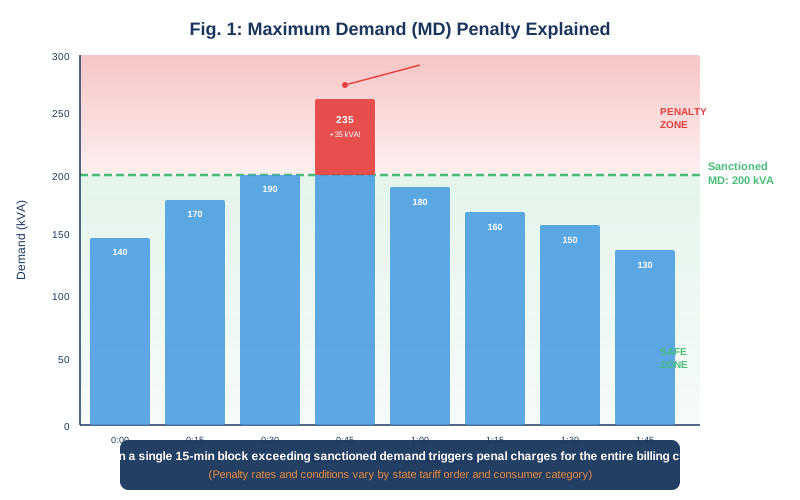
Maximum Demand (MD) is the highest demand recorded during the billing period, measured over the interval used by the utility meter for billing. It is different from connected load and different from monthly energy consumption in kWh.
For an electrical consumer, the distinction matters:
- Connected load is the total nameplate load connected to the system
- Sanctioned load or contract demand is the load approved by the utility
- Maximum demand is the highest measured demand during the billing cycle
- Billing demand is the demand value used for tariff computation under the applicable supply conditions
- Apparent power in kVA is affected by both active power and reactive power, so power factor directly influences recorded demand
In industrial installations, a short overlap of multiple heavy loads can create a high demand block even when total monthly energy consumption remains moderate.
How Billing Works
The billing demand is typically the sanctioned load or the recorded MD, whichever is higher. If the MD recorded exceeds the sanctioned load, penal charges apply under the applicable tariff schedule. The exact penalty rate, measurement interval, and conditions vary by state ESCOM, consumer category (LT or HT), and the current tariff order.
Important: Tariff treatment depends on the applicable state tariff order, consumer category, voltage level, sanctioned load, and supply conditions. Any discussion of demand charges should be read in the context of the current tariff order and utility conditions of supply.
Why SMEs Are Especially Vulnerable
SMEs are especially exposed to demand-related charges because they often operate without dedicated energy monitoring and load management systems. The usual causes are well known:
- Simultaneous starting of motors, compressors, HVAC systems, pumps, dust collectors, and CNC machines
- Poor sequencing of startup during shift change — everything switches on at once
- Low power factor, which increases apparent power in kVA for the same useful output
- Inadequate capacitor bank control or failed APFC systems
- No live visibility of demand before the bill arrives
When several loads start together, the demand spike may last only a few minutes, but that is enough to affect the billing demand recorded by the meter.
Why Manual Control Is Not Enough
Traditional advice such as "stagger the startup" or "improve power factor" is technically correct, but it is not sufficient by itself:
-
Manual staggering is unreliable in a busy production environment. A shift supervisor managing multiple machines, a compressor, and an HVAC system does not have the bandwidth to sequence startups precisely.
-
Power factor correction helps reduce kVA, but it does not prevent all demand spikes from simultaneous loads.
-
Reducing sanctioned demand without proper analysis can increase penalty exposure if actual demand remains close to the limit.
-
Legacy demand controllers often provide only basic cut-off logic and little or no analytics, remote visibility, or event history.
What SMEs need is intelligent demand supervision with proper metering, automated priority-based load control, and clear reporting.
What Intelligent Load Management Should Do
A properly designed load management system should perform four functions continuously:
- Measure real-time kW, kVA, current, voltage, power factor, energy, and demand trend at the incomer and critical feeders
- Compare live demand against sanctioned load or contract demand
- Predict whether the current trend may cross the permissible threshold
- Shed or delay only pre-authorised non-critical loads through safe control logic
This approach allows the plant to manage demand proactively rather than react only after the bill is generated.
A Practical System Architecture
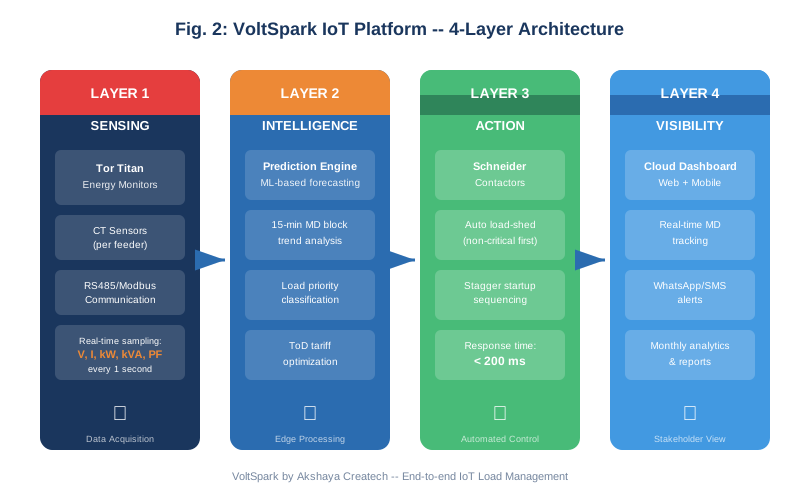
A sound IoT-based load management system can be organised in four layers.
Measurement Layer
Install energy meters at the main incomer and on selected outgoing feeders. The system should capture:
- kW, kVA, kVAR
- Voltage, current
- Power factor
- Energy consumption (kWh)
- Demand trend
Where non-linear loads are present, harmonics should also be reviewed before relying only on capacitor-based correction.
Decision Layer
The control system should continuously:
- Track live demand against the sanctioned limit
- Estimate whether the current demand block is likely to exceed the limit
- Classify loads by priority and process criticality
- Identify which loads can be delayed or temporarily disconnected
Control Layer
The system should:
- Shed only pre-approved non-critical loads
- Use properly rated contactors, relays, and interlocks
- Restore loads automatically once the demand level returns to a safe range
- Preserve process safety and equipment integrity at all times
Analytics Layer
The dashboard should show:
- Real-time demand versus sanctioned limit
- Daily, weekly, and monthly demand patterns
- Recurring spike events by time and load group
- Power factor trends
- Opportunities for tariff optimisation and operating sequence improvement
Power Factor Must Be Included
Maximum demand management cannot be separated from power factor management. When PF falls, the same useful load requires more apparent power, which increases kVA demand.
This means:
- Low PF can make a plant appear to draw more than it actually does in active power terms
- Capacitor bank health and APFC settings must be monitored continuously
- PF improvement reduces billing stress and supports better electrical efficiency
- PF correction alone is not enough if startup sequencing is still poor
In industrial systems, demand control and power factor control should operate together.
Time-of-Day Tariff Opportunity
In applicable categories, Time-of-Day (ToD) tariff can create additional savings. By shifting flexible loads away from peak periods, a plant can reduce cost without reducing productive output.
Loads that may be shifted, where process conditions permit, include:
- Water pumping
- Air compressor support loads
- HVAC pre-cooling
- Batch process auxiliaries
- Non-urgent material handling operations
The objective is not merely to consume less power. The objective is to consume power at the right time, within tariff and process constraints.
Note: ToD applicability, time slots, and incentive/penalty rates vary by state tariff order and consumer category. In Karnataka, compulsory ToD applies to certain HT categories with contract demand of 500 KVA and above, while optional ToD is available for other categories. Always refer to the current tariff order for applicable provisions.
A Typical SME Scenario
Consider a machining unit with several CNC machines, compressors, and HVAC loads. At shift commencement, all loads start together. The result is a sharp rise in demand, even though each individual machine is within its own rated capacity.
A proper load management strategy would:
- Sequence machine startup across a controlled time window
- Delay secondary compressors until the primary system stabilises
- Start HVAC in advance where the process allows it
- Avoid starting all non-essential auxiliary loads at the same moment
- Monitor PF and capacitor bank behaviour continuously
This approach reduces the risk of excess demand and improves plant electrical discipline.
Why IoT Makes This Practical
IoT-based load management is practical because it combines measurement, control, and reporting in one system. A properly designed platform can:
- Read meters in real time
- Make control decisions at the edge, without depending on cloud connectivity
- Operate even if internet is temporarily unavailable
- Provide historical data for analysis and audit
- Support expansion from main incomer monitoring to per-machine monitoring
This makes demand control accessible for SMEs that do not have a full-time energy management team.
Getting Started: A Practical Roadmap
Phase 1: Measure (Week 1–2)
- Install smart energy monitoring at the main incomer
- Record at least two weeks of demand data at the metering interval
- Identify when demand spikes occur and how often they repeat
Phase 2: Analyse (Week 3)
- Map demand spikes to plant events (shift start, compressor cut-in, HVAC operation)
- Identify loads that can be temporarily delayed
- Create a load priority hierarchy with operations and maintenance teams
Phase 3: Automate (Week 4–6)
- Deploy an intelligent demand controller with auto-shedding
- Configure demand thresholds and load priorities
- Test the shed and restore sequence during normal plant operation
Phase 4: Optimise (Ongoing)
- Review monthly demand trends
- Implement tariff-based load shifting where applicable
- Expand monitoring to feeder level or machine level as needed
- Reassess sanctioned demand only after the demand pattern is stable and under control
The Bigger Picture
For Indian SMEs competing on thin margins in manufacturing, food processing, printing, and other energy-intensive operations, electricity is typically one of the largest operating costs after raw materials and labour.
Yet most SMEs treat electricity as a fixed, uncontrollable expense — a bill to be paid, not a system to be optimised.
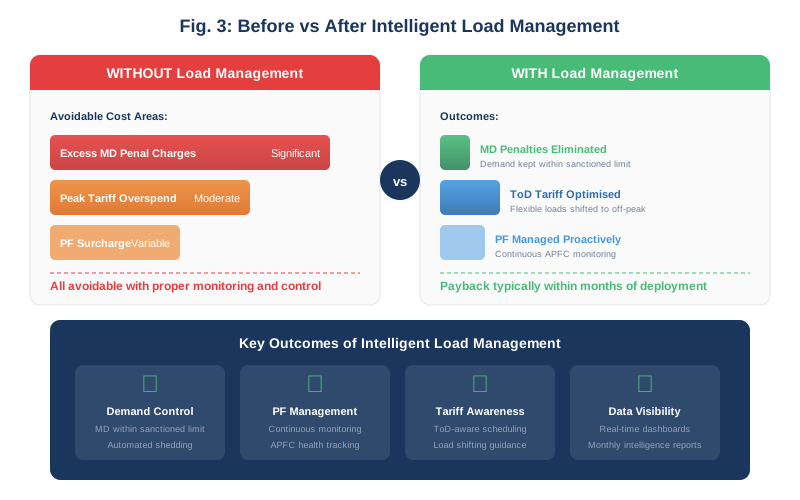
Intelligent load management changes that. It helps the plant:
- Avoid excess maximum demand
- Improve power factor
- Reduce avoidable demand charges
- Use tariff windows more effectively
- Gain visibility into electrical behaviour
- Make better operational decisions based on data
Intelligent load management is not just an automation feature. It is an electrical discipline that combines demand control, power factor management, sequencing, and tariff awareness into one practical solution for industrial cost control.
Note: Tariff provisions, penalty rates, power factor surcharge rules, and Time-of-Day applicability vary by state, ESCOM, consumer category, and are subject to periodic revision. The information in this article is intended as general guidance. For specific tariff applicability, refer to the current tariff order issued by your state electricity regulatory commission and the conditions of supply of your distribution licensee.