The Blind Factory Problem
Walk into any mid-sized Indian factory today and ask the plant manager a simple question: "What was your power factor at 2 AM last Thursday?" You will almost certainly be met with a blank stare. Now ask, "Which of your twenty motors consumed the most energy last month?" Same response. This is not a reflection of incompetence — it is a reflection of an industry that has operated for decades on monthly electricity bills and little else.
From the industrial electrical perspective: In four decades of working with industrial electrical systems across Karnataka and beyond, I have seen factories invest crores in machinery while treating their electrical distribution as an afterthought. The main panel gets an energy meter because the utility demands it. Sub-panels, motor feeders, compressor circuits — these remain invisible. Operators know something is wrong only when a breaker trips or a motor burns out. By then, the damage — both financial and operational — is already done.
From the embedded systems perspective: The irony is striking. We can track a package across continents in real time, yet a 200 HP motor running 24/7 in a factory has zero data trail. The technology to monitor every circuit in a factory has existed for years. What has been missing is the bridge between the IT/IoT world and the industrial electrical world. That bridge is what this article is about.
Why Monitoring Matters Before Optimization
There is a temptation to jump straight to solutions — install solar panels, add capacitor banks, replace old motors with IE3 units. But optimization without data is guesswork. You cannot improve what you do not measure.
Consider what even basic monitoring reveals:
- Phantom loads: Equipment drawing power during off-hours. In one textile unit we surveyed, compressed air systems were consuming 15% of total energy while the factory was shut for the night.
- Power factor penalties: Many factories pay 5-15% extra on their bills due to poor power factor, unaware that targeted capacitor placement could eliminate the penalty entirely.
- Unbalanced phases: A common problem in Indian installations where single-phase loads are not distributed evenly, leading to overheated neutrals and premature equipment failure.
- Peak demand spikes: Staggering motor starts by even 30 seconds can reduce maximum demand charges significantly.
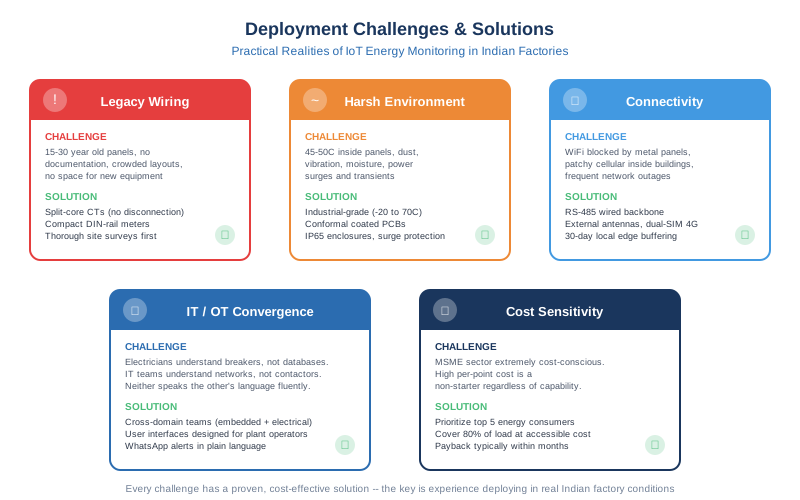
The ROI from monitoring alone — before any capital investment in optimization — can be significant, though the actual savings depend on the facility's tariff category, existing electrical practices, and the nature of inefficiencies discovered. In our experience across multiple deployments, the payback period for a well-designed monitoring system is typically measured in months, not years.
The Technology Stack: From Meter to Dashboard
Building a reliable industrial energy monitoring system requires getting every layer right.
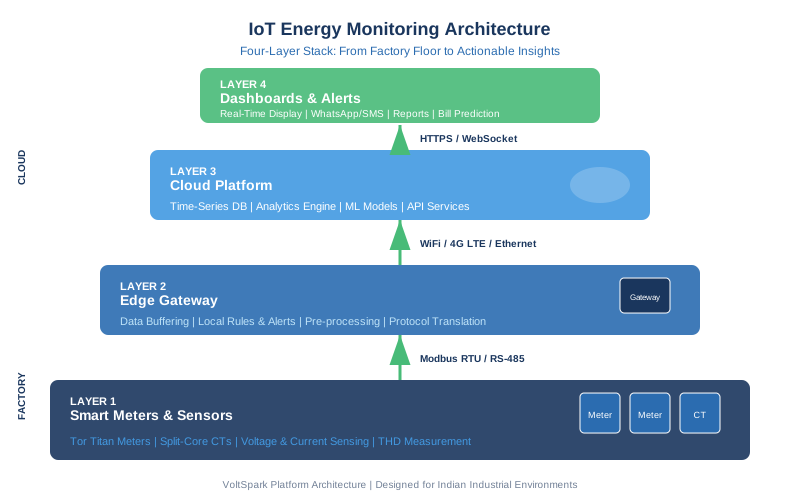
Layer 1: Smart Meters and Sensors
The foundation is accurate measurement. Modern smart energy meters like the Tor Titan series provide multi-parameter measurement — voltage, current, power (active, reactive, apparent), power factor, frequency, THD (Total Harmonic Distortion) — all from a single device.
Meters should comply with IS 14697 (AC static multifunction meters), ensuring accuracy and compatibility with utility metering standards. CEA regulations govern metering requirements for electrical installations, and any monitoring system should be designed to complement these requirements.
For Indian factory environments, meter selection must account for:
- Wide voltage tolerance (Indian grids can swing 15-20% from nominal)
- CT (Current Transformer) compatibility for retrofit installations — split-core CTs on individual phase conductors allow per-phase current monitoring, making phase imbalance visible for the first time in many legacy installations
- DIN-rail mounting to fit existing panel layouts
- Communication interfaces — this is where the embedded world comes in
Layer 2: Communication and Edge
This is where many monitoring projects stumble. A smart meter sitting in a panel is useless if its data cannot reach the outside world reliably.
The meter speaks Modbus RTU over RS-485 — a robust serial protocol designed for noisy industrial environments. RS-485 can run reliably over hundreds of meters of twisted-pair cable, even alongside power cables. Multiple meters daisy-chain on a single RS-485 bus, each with a unique address.
An edge gateway sits at the convergence point — a small industrial-grade computing device that translates between the factory floor and the internet. The gateway:
- Polls meters over RS-485/Modbus at regular intervals (typically every 1-15 seconds)
- Buffers data locally (critical for when connectivity drops)
- Pre-processes readings (aggregation, anomaly flagging, compression)
- Transmits to the cloud over WiFi, 4G/LTE, or Ethernet
On edge design: The gateway is the most underappreciated component in the stack. In our VoltSpark platform, we have learned that edge intelligence is not optional — it is essential. Indian factory internet connectivity is unreliable. A gateway that simply forwards data to the cloud will lose readings during outages. Ours stores up to 30 days of data locally and syncs when connectivity resumes. It also runs local rules — if current exceeds a threshold, the alert fires from the edge, not from a server thousands of kilometers away.
Layer 3: Cloud Platform
Once data reaches the cloud, the real analytical power kicks in:
- Time-series storage optimized for millions of data points per day
- Real-time processing for dashboards and alerts
- Historical analysis for trend identification
- Machine learning models for anomaly detection and predictive maintenance
- Benchmarking engines that compare similar machines or shifts
Layer 4: User Interface — Dashboards and Alerts
Data is only valuable if it reaches the right person at the right time:
- Real-time dashboards showing live power consumption, power factor, and load distribution
- Mobile alerts via SMS or WhatsApp when parameters exceed thresholds
- Shift-wise and machine-wise reports for the plant manager
- Monthly executive summaries for management
- Bill prediction so there are no end-of-month surprises
Practical Deployment Challenges (and How to Overcome Them)
Theory is clean. Indian factories are not. Here are the real-world challenges we have encountered and the solutions that work.
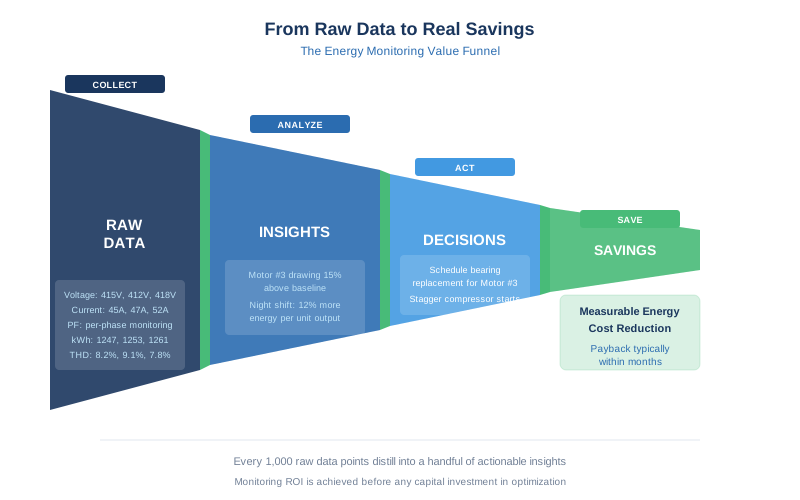
Legacy Wiring and Panels
Most Indian factories have electrical panels that were installed 15-30 years ago. Documentation is often missing or outdated. Panels are crowded, with little space for additional equipment. Wiring practices should comply with IS 732 (Code of Practice for Electrical Wiring Installations), and any monitoring installation must respect existing wiring standards and panel configurations.
The solution: Non-invasive split-core CTs that clamp around existing cables without disconnection. Compact DIN-rail meters that fit in existing panel gaps. Thorough site surveys before any hardware is ordered.
Unbalanced phases are a common and often undetected problem in Indian industrial installations where single-phase loads are not distributed evenly across the three phases. This leads to overheated neutrals, increased losses, and premature equipment failure. Retrofit split-core CTs on individual phase conductors allow per-phase current monitoring, making phase imbalance visible for the first time in many legacy installations — often revealing issues that have been silently degrading equipment and inflating losses for years.
Harsh Environments
Factory panels face heat (45-50°C inside panels during Indian summers), dust, vibration, and occasionally moisture. Consumer-grade IoT devices fail within months.
The solution: Industrial-grade components rated for extended temperature ranges (-20 to 70°C). Conformal coating on PCBs. IP65-rated enclosures for gateways. Surge protection on every communication line — Indian power grids are notorious for transients.
Connectivity in the Factory
WiFi signals struggle to penetrate metal panel enclosures and reinforced concrete factory walls. Cellular coverage can be patchy inside industrial buildings.
The solution: RS-485 wired backbone within the factory. Gateway placement outside panels with external antennas. Dual-SIM 4G failover for critical installations. And always, always, local buffering at the edge.
IT/OT Convergence
This is perhaps the most underestimated challenge. The factory electrician understands contactors and breakers. The IT team understands networks and databases. Neither speaks the other's language fluently. Successful deployments require a team that bridges both worlds.
Cost Sensitivity
Indian manufacturers, especially in the MSME sector, are extremely cost-conscious. A monitoring system that costs Rs. 50,000 per measurement point is a non-starter.
The solution: Prioritize monitoring points based on impact. Start with the main incomer and the top five energy consumers (typically compressors, large motors, and HVAC). A well-designed system covering the majority of a factory's energy consumption can be deployed at a cost that is typically recoverable within months from the savings identified.
From Monitoring to Intelligence: What the Data Enables
Once a factory is instrumented and data is flowing, the possibilities expand rapidly.
Anomaly Detection
A motor that normally draws 45A is now drawing 52A at the same load. Is the bearing failing? Is the coupling misaligned? The monitoring system flags this weeks before a catastrophic failure, enabling planned maintenance rather than emergency shutdowns.
Load Management
With visibility into every major load, intelligent sequencing becomes possible. Instead of all compressors starting simultaneously after a power cut, the system staggers restarts automatically. Peak demand charges drop measurably.
Solar Integration
More factories are exploring rooftop solar every year. But solar integration without monitoring is flying blind. You need to know your load profile to size the system correctly. The monitoring system is a prerequisite for intelligent solar deployment, not an add-on.
Benchmarking and Continuous Improvement
When you can compare energy consumption per unit of production across shifts, across machines, across months — patterns emerge. Why does the night shift use 12% more energy for the same output? Data transforms these from mysteries into solvable problems.
The Path Forward
Indian manufacturing is at an inflection point. Energy costs are rising. Carbon reporting requirements are tightening. Global buyers increasingly demand supply chain sustainability data. For facilities pursuing ISO 50001 certification for energy management systems, an IoT monitoring platform provides the continuous measurement and verification infrastructure that the standard requires.
The regulatory framework is also evolving. CEA (Measures Relating to Safety and Electric Supply) Regulations set requirements for metering and electrical safety that any monitoring system must complement. Standards like IS 14697 for multifunction meters and IS 732 for wiring installations define the baseline that IoT deployments build upon, not replace.
The technology is mature. The costs are accessible. The ROI is proven. What remains is execution — and that requires bridging the gap between the IoT world and the industrial electrical world.
That bridge is not built with technology alone. It is built with the combined experience of people who understand both sides: how a Modbus register maps to a real-world current transformer, how an MQTT message translates into an actionable alert for a plant electrician, how a cloud dashboard must reflect the reality of a factory floor in Peenya or Hosur or Pune.
This is the work we are committed to — making Indian factories not just connected, but genuinely intelligent about their energy consumption.