The commercial kitchen is undergoing its most significant transformation since the adoption of gas burners. As induction cooking matures and IoT infrastructure becomes affordable, the convergence of sensor fusion, edge computing, and cloud analytics is giving rise to a new category: the intelligent commercial kitchen.
The State of Commercial Kitchens in India
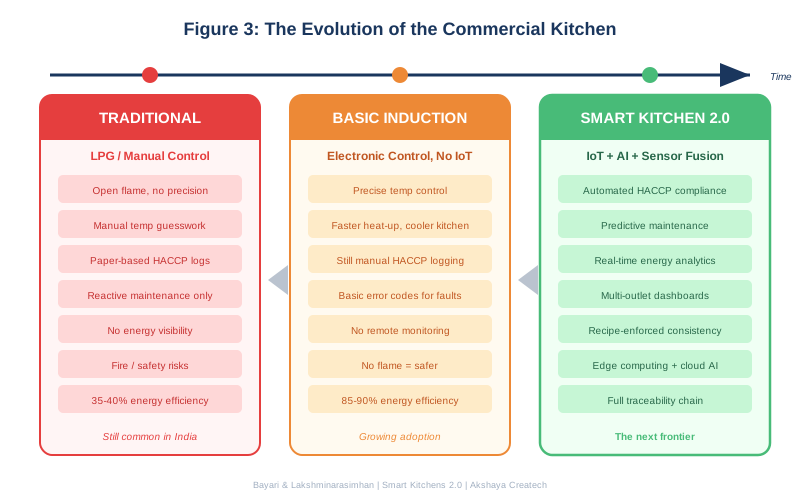
India's commercial food-service sector is expanding rapidly. Quick-service restaurant chains, cloud kitchens, institutional caterers, and hotel groups are scaling operations across dozens — sometimes hundreds — of outlets. Yet the majority of commercial kitchens in the country still rely on LPG-based cooking with manual temperature control and paper-based compliance records.
This creates a familiar set of problems: inconsistent food quality across outlets, energy waste from unmonitored burners, delayed detection of equipment failures, and HACCP documentation that is completed retroactively — or not at all. Fire safety remains a persistent concern, and operators have limited visibility into what happens inside a kitchen once a shift begins.
The first wave of improvement came with the adoption of commercial induction cooking — precise temperature control, faster heat-up times, cooler kitchen environments, and measurable energy savings over LPG. But standalone induction, however efficient, still operates in isolation. The cooktop does not know what is being prepared, the kitchen manager cannot see energy consumption in real time, and compliance data must still be recorded manually.
Smart Kitchens 2.0 changes this by connecting every piece of equipment, every sensor, and every process into an integrated, intelligent system.
Sensor Fusion: The Foundation of Kitchen Intelligence
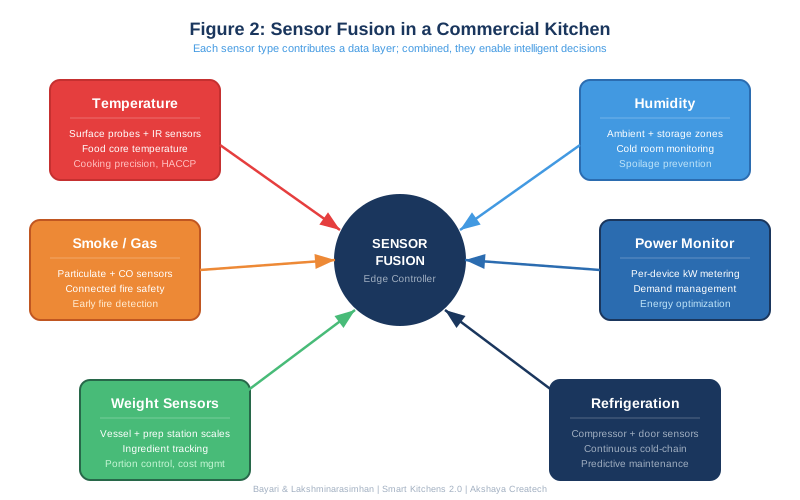
The term "sensor fusion" refers to the combination of data from multiple sensor types to create a unified, context-aware understanding of an environment. In a commercial kitchen, this means deploying an array of sensors that individually provide narrow data streams but collectively paint a complete operational picture.
Temperature sensors — both contact probes on cooking surfaces and non-contact infrared sensors monitoring food — provide the most fundamental data layer. In an induction-based kitchen, the cooktop already has precise electronic control over coil temperature. Adding food-core temperature probes and ambient kitchen temperature monitoring extends this into a full thermal map of the cooking process.
Humidity sensors track moisture levels in the kitchen environment and inside storage areas. Elevated humidity in dry-storage zones can signal refrigeration failures or ventilation problems before inventory is compromised.
Smoke and gas detectors, when connected to the IoT layer rather than operating as standalone alarms, contribute to a real-time safety profile. A spike in particulate matter near a specific cooking station can trigger an alert before visible smoke appears, and the system can cross-reference the event with the recipe being prepared at that station to determine whether the reading is expected (high-temperature searing) or anomalous (overheating due to an empty vessel).
Power monitoring sensors on each induction unit and peripheral appliance provide granular energy consumption data, enabling real-time energy optimization and long-term trend analysis.
Weight sensors integrated into cooking vessels or prep stations can track ingredient quantities, portion sizes, and stock depletion. When combined with recipe management software, weight data closes the loop on food cost control and consistency.
The value of sensor fusion lies not in any single data stream but in the correlations between them. A rising surface temperature combined with decreasing vessel weight and stable food-core temperature may indicate that a sauce is reducing as expected. The same surface temperature with rapidly increasing food-core temperature and rising smoke-detector readings may indicate that a dish is burning. The system can distinguish between these scenarios and respond appropriately.
Architecture: From Cooktop to Cloud
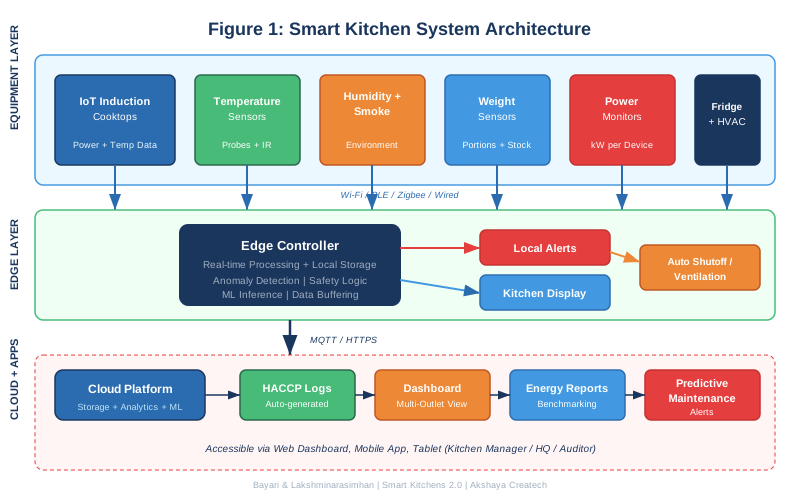
A Smart Kitchen 2.0 deployment follows a three-tier architecture.
The equipment layer consists of IoT-enabled induction cooktops, connected sensors, and smart peripherals. Each device communicates over a local network — typically a combination of wired connections for high-reliability equipment and wireless protocols (Wi-Fi, BLE, or Zigbee) for distributed sensors.
The edge layer is a local compute node — an industrial-grade microcontroller or single-board computer installed in the kitchen — that aggregates sensor data, runs real-time decision logic, and communicates with the cloud. Edge computing is essential in kitchen environments for two reasons:
- Latency: A safety alert triggered by a smoke sensor cannot wait for a round-trip to a remote server. The edge controller must process the signal and actuate a response within milliseconds.
- Resilience: Kitchens operate in environments where internet connectivity may be intermittent, and cooking operations must not depend on cloud availability.
The edge controller runs lightweight inference models for anomaly detection, recipe-step monitoring, and equipment health scoring.
The cloud layer provides long-term storage, advanced analytics, multi-outlet aggregation, and the operator-facing dashboard. This is where HACCP logs are compiled, energy reports generated, predictive maintenance models trained on fleet-wide data, and chain-wide performance comparisons surfaced.
HACCP Compliance: From Paperwork to Automation
HACCP compliance is a regulatory requirement for commercial food preparation, and it is one of the areas where IoT delivers the most immediate, tangible return on investment.
Traditional HACCP logging requires kitchen staff to manually record temperatures at critical control points at defined intervals. In practice, these records are often filled in at the end of a shift from memory, or fabricated entirely.
In a Smart Kitchen 2.0 environment, HACCP data is captured automatically and continuously. Temperature sensors at critical control points log readings at configurable intervals. The system flags deviations in real time: if a holding station drops below the required temperature, the kitchen manager receives an immediate alert, and the deviation is logged with a timestamp, duration, and corrective action taken.
Audit readiness becomes a byproduct of normal operations rather than a separate administrative burden. Compliance reports can be generated on demand, covering any time period, any outlet, and any specific control point.
Predictive Maintenance and Equipment Health
Commercial kitchen equipment operates under harsh conditions — high temperatures, moisture, grease, and heavy daily use. Unplanned equipment failures during service hours are costly.
Sensor fusion enables a shift from reactive maintenance (fix it when it breaks) to predictive maintenance (fix it before it breaks). By continuously monitoring power draw, thermal profiles, vibration patterns, and operational cycles, the system builds a baseline model of normal equipment behavior. Deviations — a compressor drawing increasing power, an induction coil showing irregular thermal response, an exhaust motor with increasing vibration — are flagged as early warnings.
Over time, fleet-wide equipment data allows operators to make informed decisions about equipment lifecycle management, comparing performance degradation curves across brands, models, and usage patterns.
Energy Optimization at Scale
Energy is one of the largest controllable costs in commercial kitchen operations. Induction cooking already offers 85–90% energy transfer efficiency compared to 35–40% for gas. Smart Kitchen 2.0 takes optimization further.
Real-time power monitoring enables demand management: staggering startup of high-draw appliances to avoid peak-demand charges, identifying equipment left running unnecessarily, and benchmarking energy consumption per meal served across outlets.
Analytics dashboards present energy data alongside operational metrics — covers served, menu mix, ambient temperature — allowing operators to understand not just how much energy is consumed but why. Some operators have reported 15–25% additional energy savings after deploying monitoring on top of the base induction efficiency gain.
Food Quality Consistency Across Outlets
For chain operators, Smart Kitchen 2.0 extends beyond safety and efficiency to the core business challenge: delivering the same food quality at every outlet, every time.
Recipe management systems integrated with induction controls can enforce cooking parameters — temperature profiles, timing sequences, power levels — for each menu item. When a cook selects a recipe on the station display, the induction unit automatically sets the correct power curve. Deviations are logged, and repeated non-compliance triggers training recommendations.
Combined with weight-sensor data for portioning and temperature-probe data for doneness, the system creates a digital quality record for every dish prepared.
Chain-Wide Analytics and Multi-Outlet Operations
The cloud layer aggregates data from all connected outlets into a unified analytics platform. For a chain operator managing 50 or 100 kitchens, this provides:
- Comparative energy benchmarking across outlets with different layouts, equipment ages, and menu mixes
- Centralized HACCP compliance monitoring with real-time dashboards showing every outlet's status
- Equipment fleet management with predictive maintenance scheduling across all locations
- Menu engineering insights from cooking-station utilization, preparation times, and energy cost per dish
- Anomaly detection that surfaces outlier behavior at specific outlets for investigation
Edge Computing: Why the Kitchen Needs Local Intelligence
The decision to process data at the edge is a practical necessity shaped by the kitchen environment.
Commercial kitchens are hot, humid, and often located in buildings with inconsistent network infrastructure. A cloud-dependent system that loses functionality during an internet outage is unacceptable when food safety is at stake. Edge controllers ensure all safety-critical functions — over-temperature shutdowns, smoke-response protocols, HACCP deviation alerts — operate independently of cloud connectivity.
As edge hardware becomes more capable, the potential for on-device machine learning grows. Future kitchen edge controllers may run computer vision models for plating quality inspection, voice-command interfaces for hands-free recipe navigation, and reinforcement-learning models that optimize cooking parameters based on local conditions.
The Road Ahead
The intelligent commercial kitchen is not a distant vision. The building blocks — commercial induction with electronic control, affordable IoT sensors, edge computing hardware, and cloud analytics platforms — are available today.
The next phase involves deepening sensor integration, expanding the analytics layer with machine learning, and building the ecosystem of connected kitchen peripherals that will make the kitchen a fully instrumented environment.
For Indian food-service operators navigating rapid expansion, rising energy costs, tightening food-safety regulations, and increasing customer expectations for consistency, the Smart Kitchen 2.0 is not a luxury. It is becoming a competitive necessity.